TL residence
TOTAL FLOOR: 23.7P(78.9㎡)
PRINCIPAL USE: RESIDENCE
COMPLETION DATE: 2024.01-2025.02
SITE: TAIPEI CITY DESIGNER: SHIHCHIEH JENG + HUITING HSU
Aftertaste 余味
空間的語言,並不急於以表象定義,而在於進入、停留與離去之間,留下沉浸而豐盈、卻不喧嘩的感受。
品味與空間的成形亦若酒。
結構決定骨架,材質承載溫度,細節在時間中逐漸顯影——有些層次清晰,有些則被留在最後,化為縈繞其間的餘韻。
The language of space is not defined through appearance alone.It reveals itself in the act of arrival, in moments of pause, and in the awareness of departure—leaving behind an experience that feels immersive and resonant, yet never insistent.
Taste, like space, is something that takes form over time.
Structure determines the framework; materials carry warmth; details slowly come into focus with time. Some layers reveal themselves clearly, while others are held back, lingering as a subtle aftertaste that remains long after.
此中古家宅的更新設計,是一次關於比例、節奏與日常秩序的重新梳理;空間設計由 JSC Studio 操刀,家具物件與軟裝陳設則由 Studio Appara 負責統籌。從空間脈絡的重塑,乃至回應屋主需求、喜好與品味的選物與細節安排,逐步疊合出耐人尋味的細膩層次。
如喚醒感知前的調整氣息,玄關由落塵區向內延伸為一段廊道,為生活預留整頓與轉換的步履;空間佈局隨機能整合,沿著廊道展開。
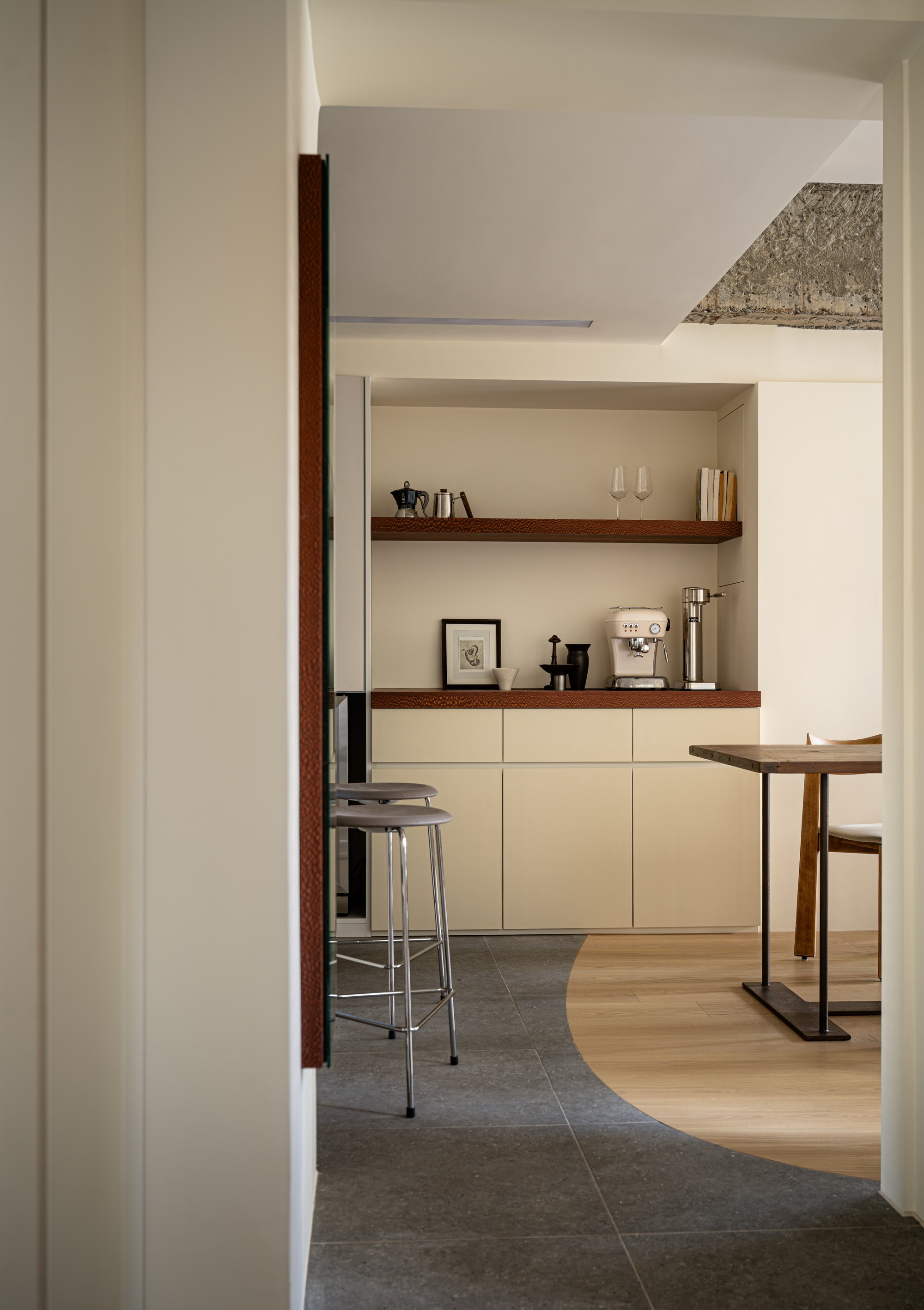
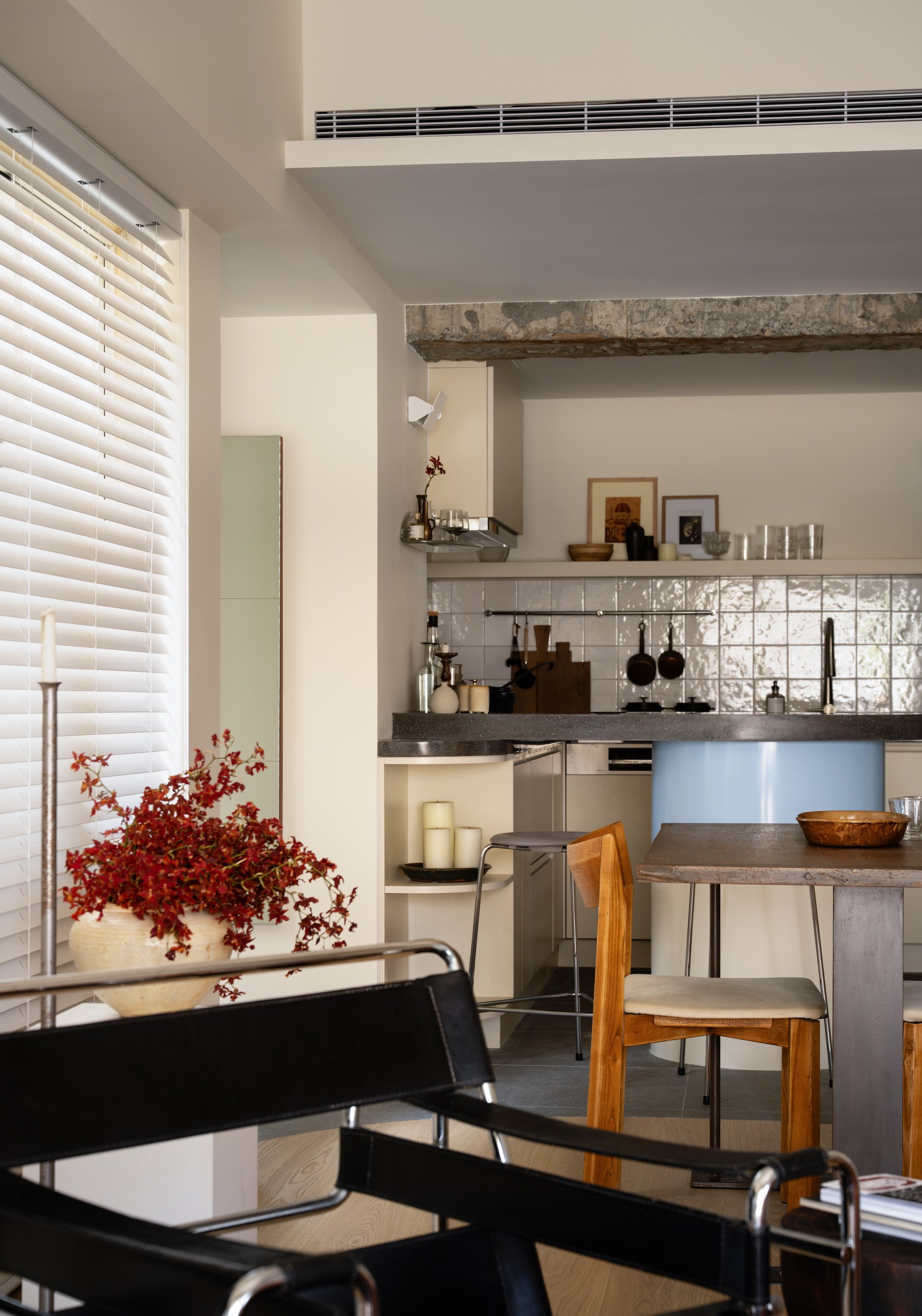
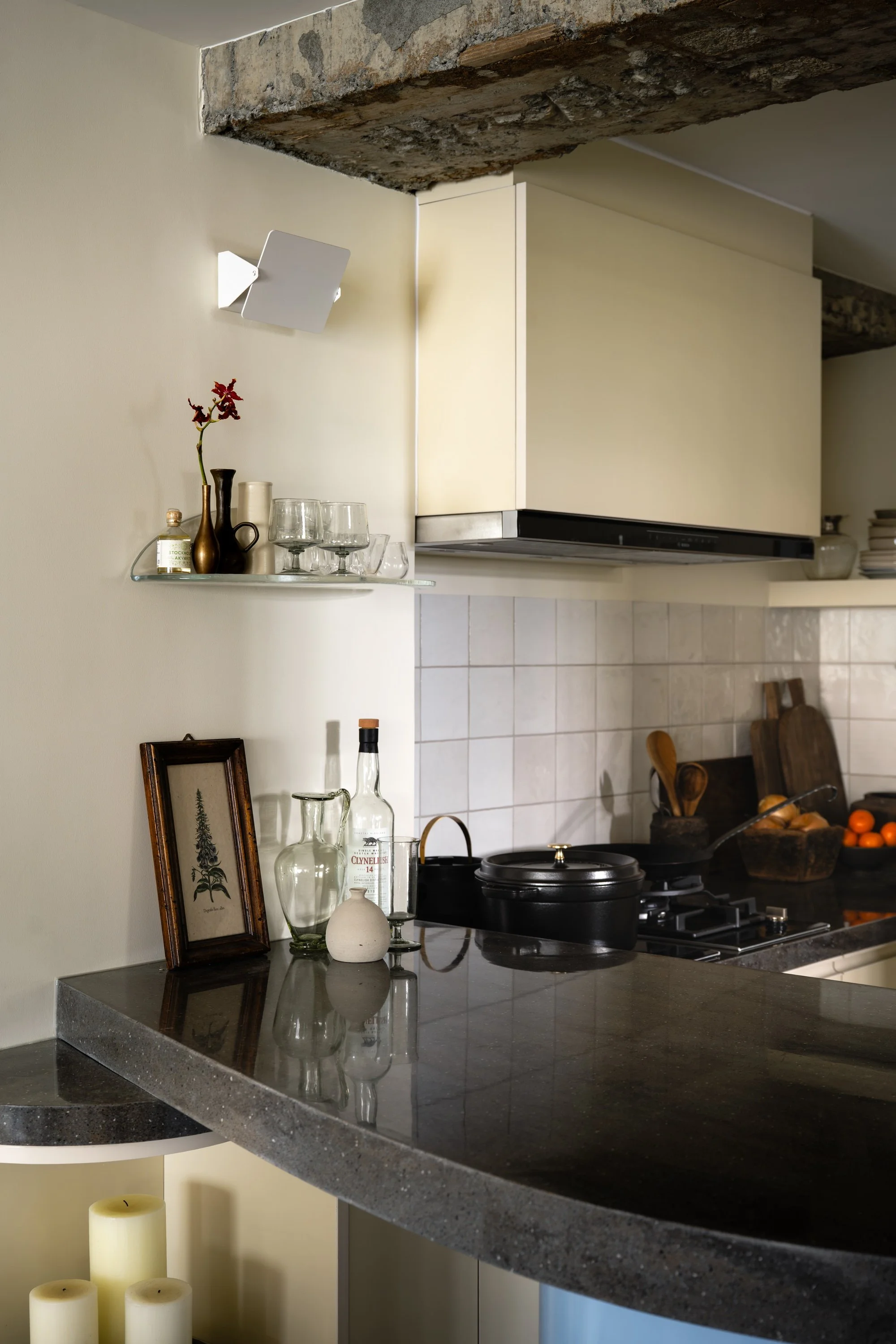
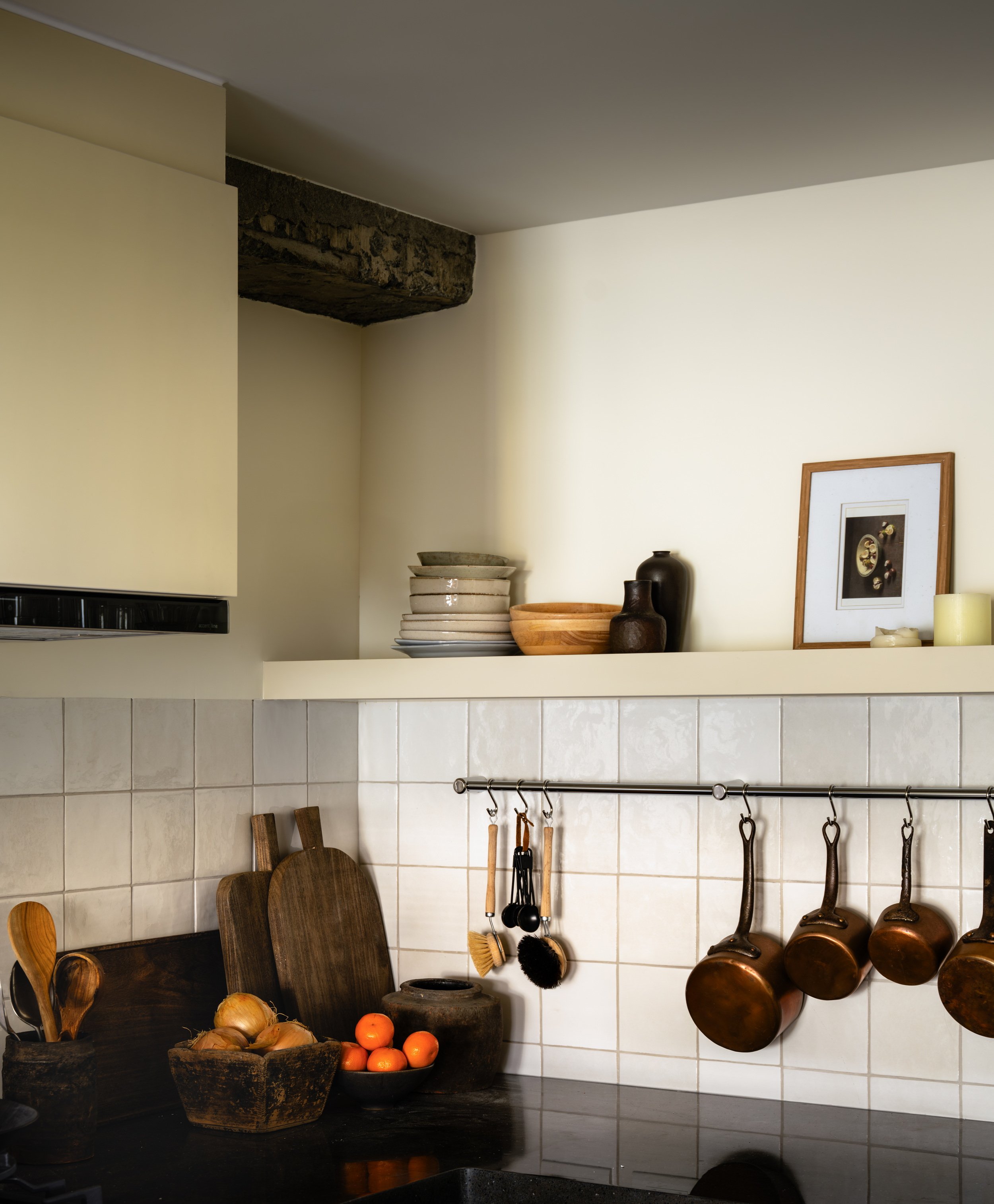
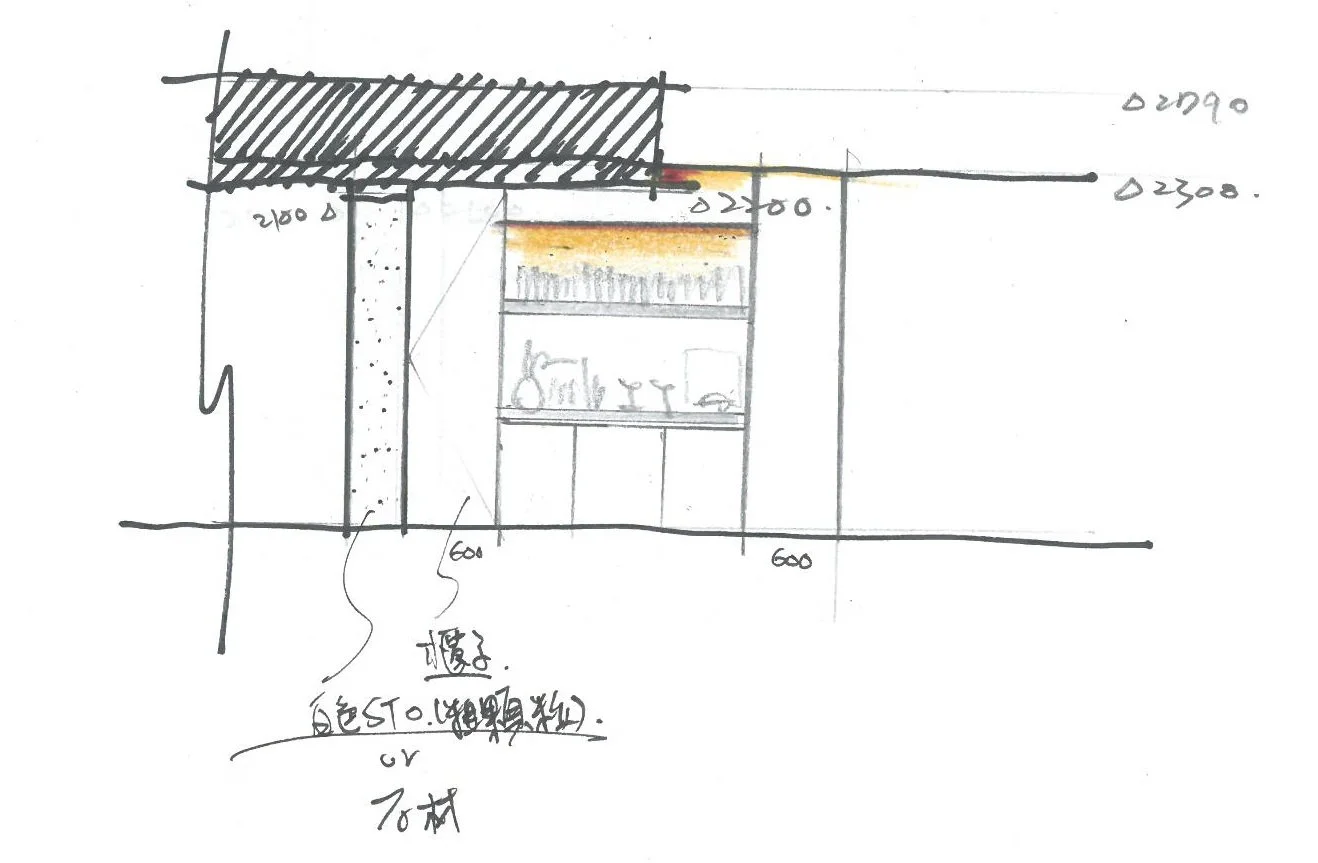
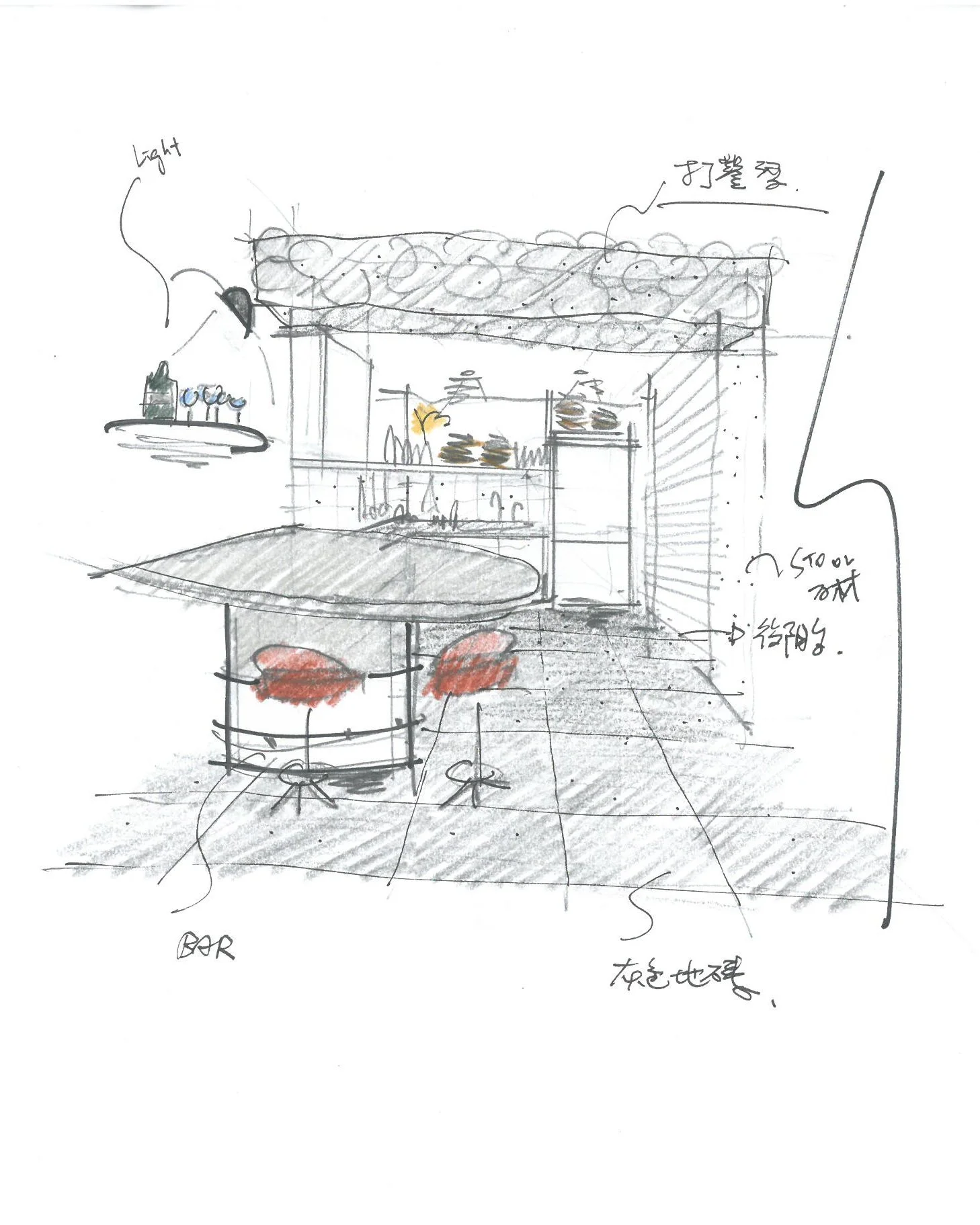
左側一隅為開放式廚房,奶油般色澤的櫥櫃交映深淺錯落的白釉磚面,鋪陳出克制而帶有玩味的細節。檯面上日常器物構成寫意的擺設,猶如留有餘溫的靜物畫面。流線造型的中島作為公共區域之間的過渡界面,對映地面的石磚銜接木質肌理;在精巧的空間運用中,界定出區域的層次。中島底座覆以一抹輕盈的霧藍,使整體在暖色基調中,透出一絲清新的空氣感。
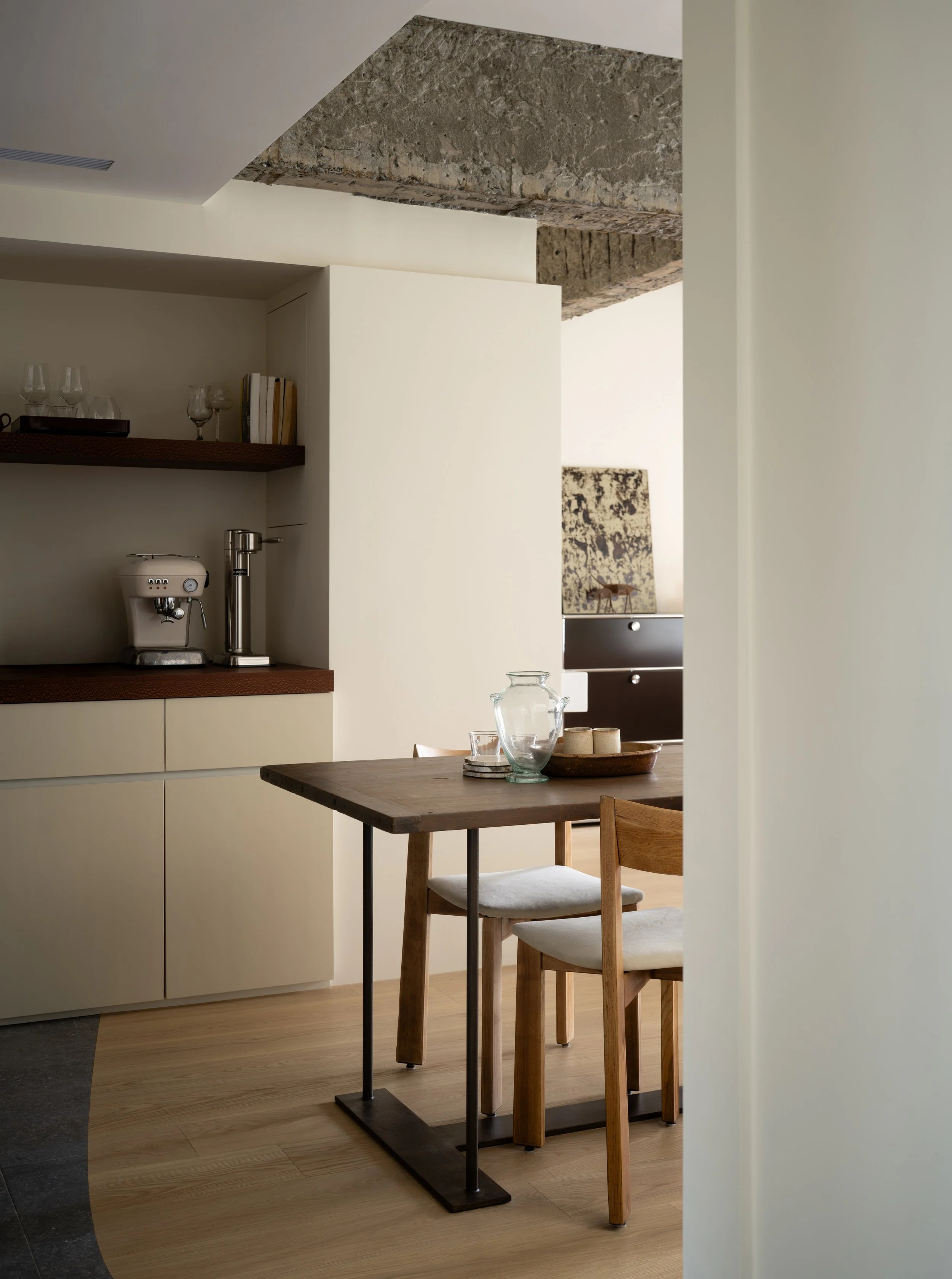
走道的右側即為餐桌區,位居延貫至客廳的動線樞紐,並將料理、備餐與用餐等流動的生活區域,集中於空間前緣;讓廚房、中島與餐桌之間形成連續而精實的使用軸線。
The renovation of this previously lived-in residence is a recalibration of proportion, rhythm, and everyday order. Spatial design was led by JSC Studio, while furniture selection and soft furnishings were curated by Studio Appara. From the rearticulation of spatial relationships to the considered selection of objects and details that respond to the homeowners’ needs, preferences, and sensibilities, layers of subtlety are assembled—precise, restrained, and composed.
Like a pause taken to steady the senses, the entry unfolds from the threshold into a transitional corridor, allowing space for composure and adjustment before daily life takes shape. Functional zones are integrated along this passage, progressing sequentially as the layout opens up.
To the left, an open kitchen anchors the space. Cream-toned cabinetry is set against white-glazed tiles in shifting depths, establishing a palette that remains measured yet lightly inflected with playfulness. On the countertop, the arrangement of everyday objects composed almost like a still life, retaining a trace of warmth.A streamlined island serves as a transitional interface between shared zones, aligning stone tiling with the grain of timber underfoot. Through precise spatial calibration, it defines layers of use while maintaining continuity. The island’s base is finished in a light misty blue, introducing a note of coolness within an otherwise warm tonal field.
Along the right side of the corridor lies the dining area, positioned at a key hinge in the circulation extending toward the living room. Cooking, preparation, and dining are gathered along the front edge of the plan, forming a compact and continuous axis between kitchen, island, and table.
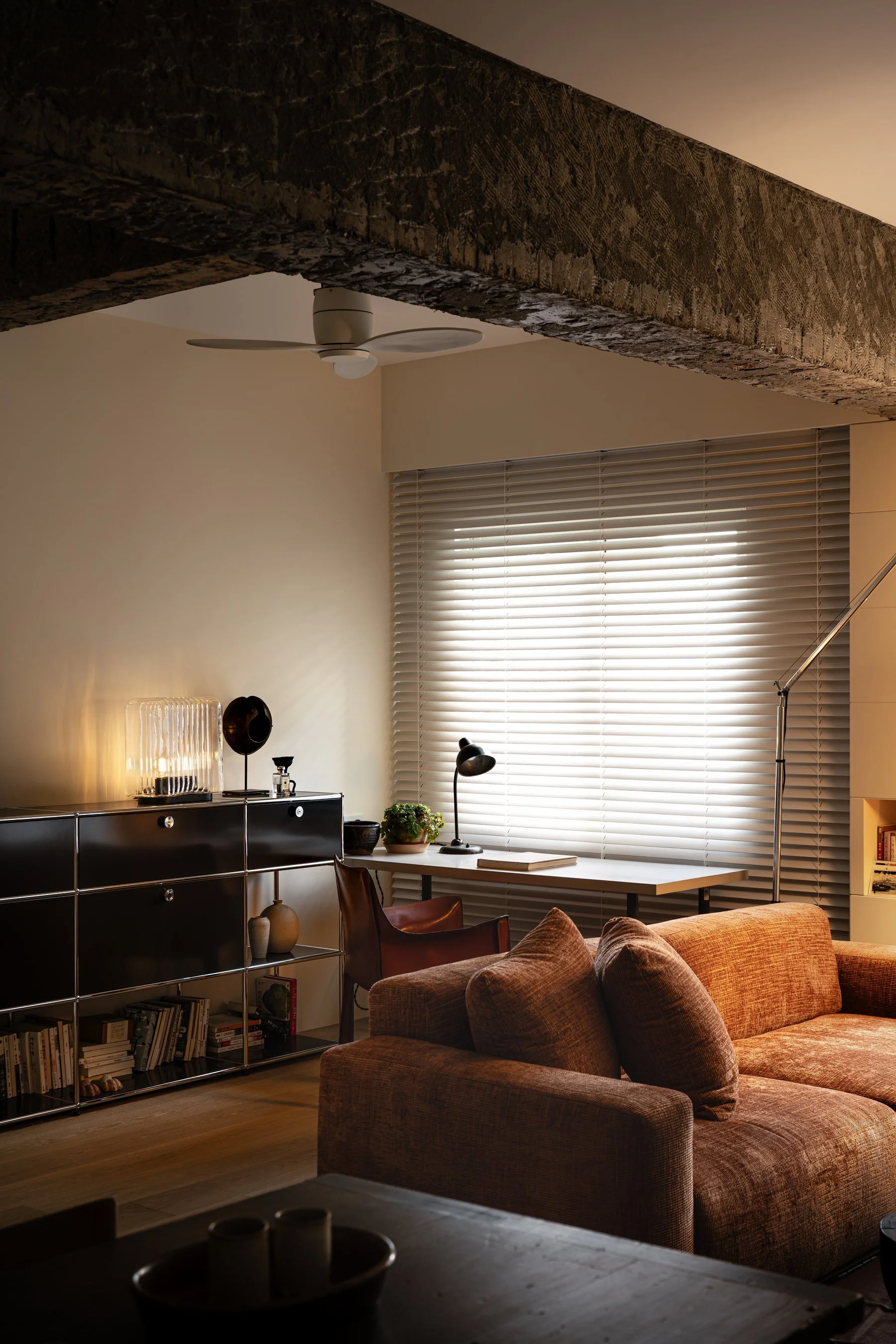
主空間將位居後側的工作區,與前方的客廳整合為一複合機能的起居場域。
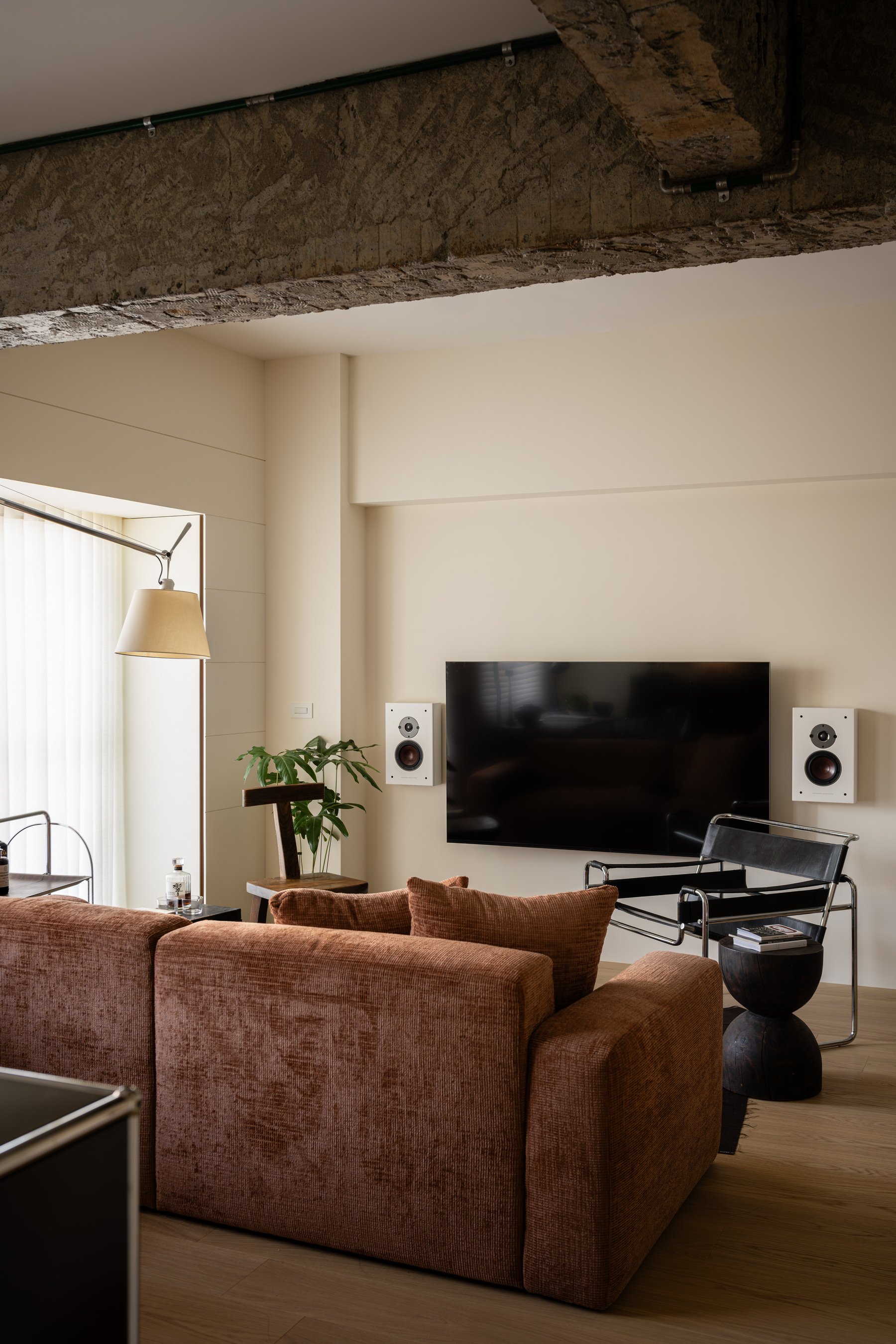
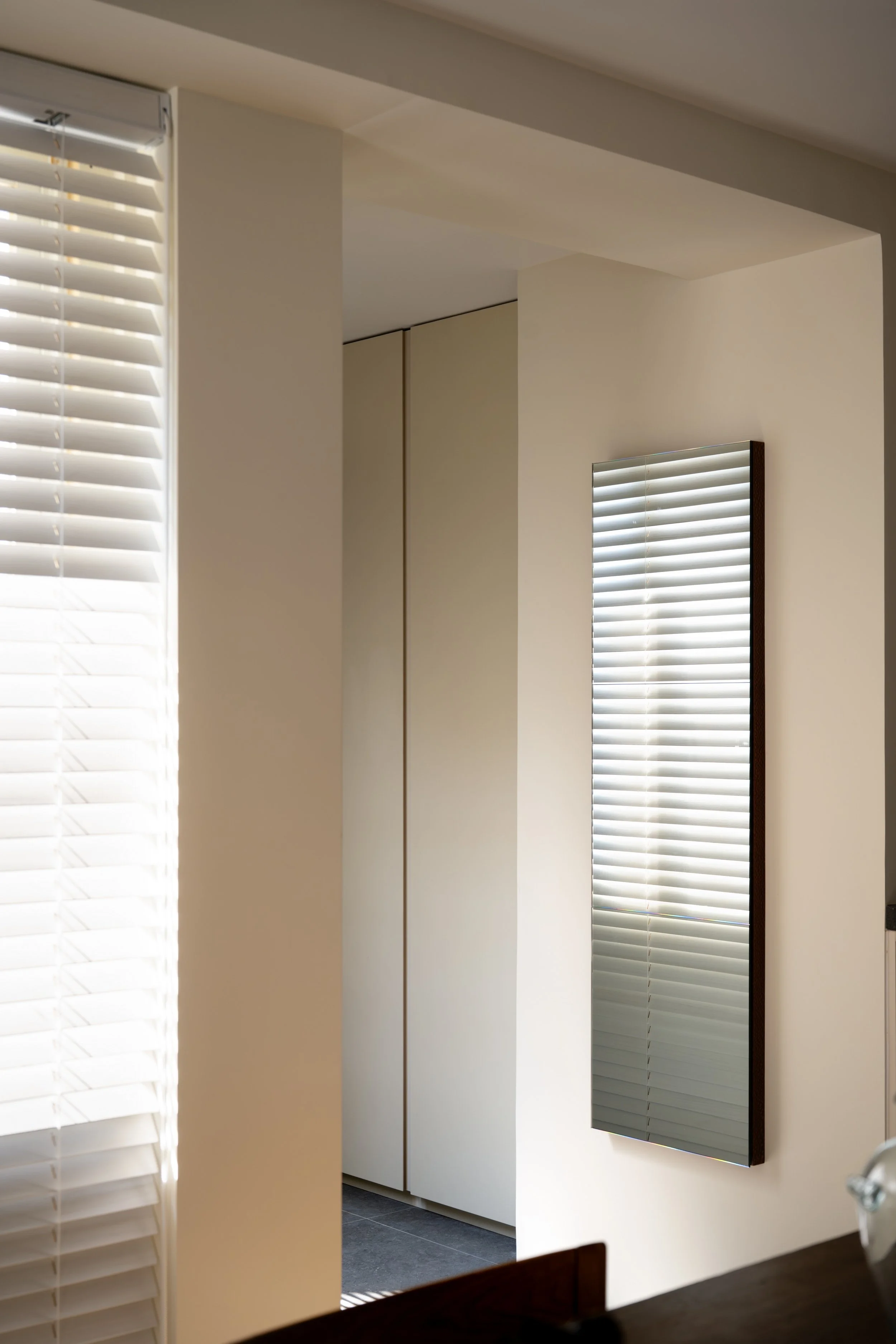
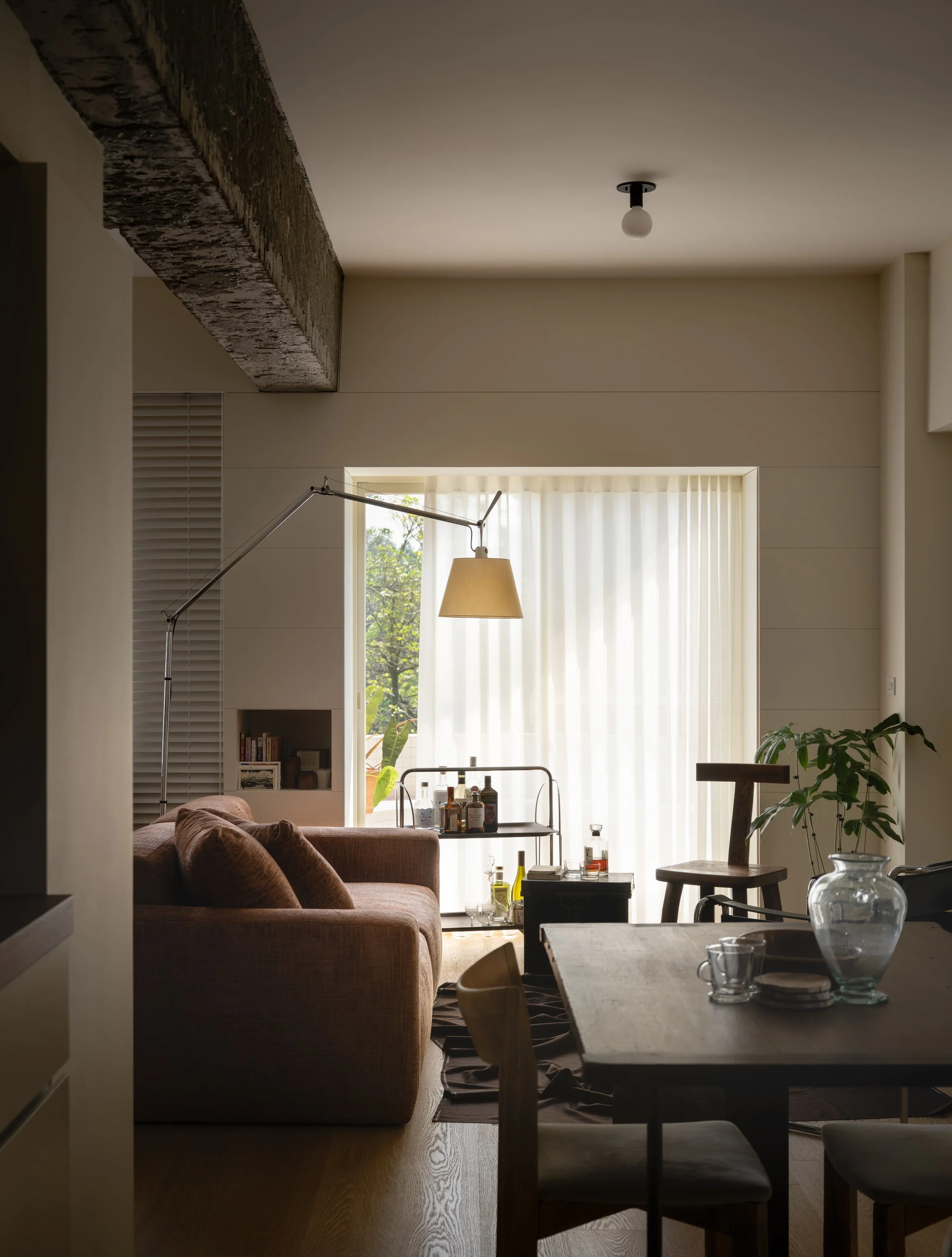
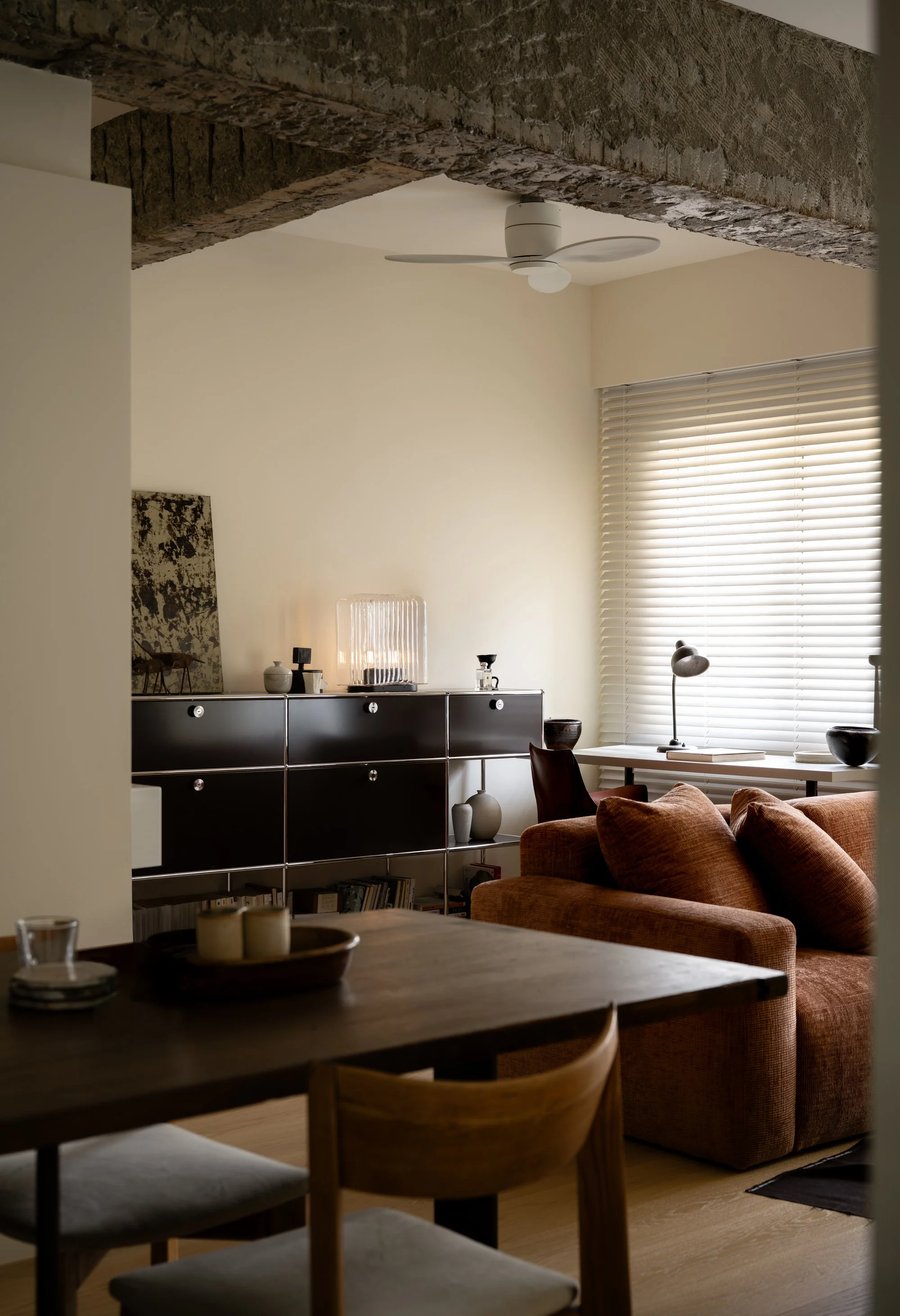
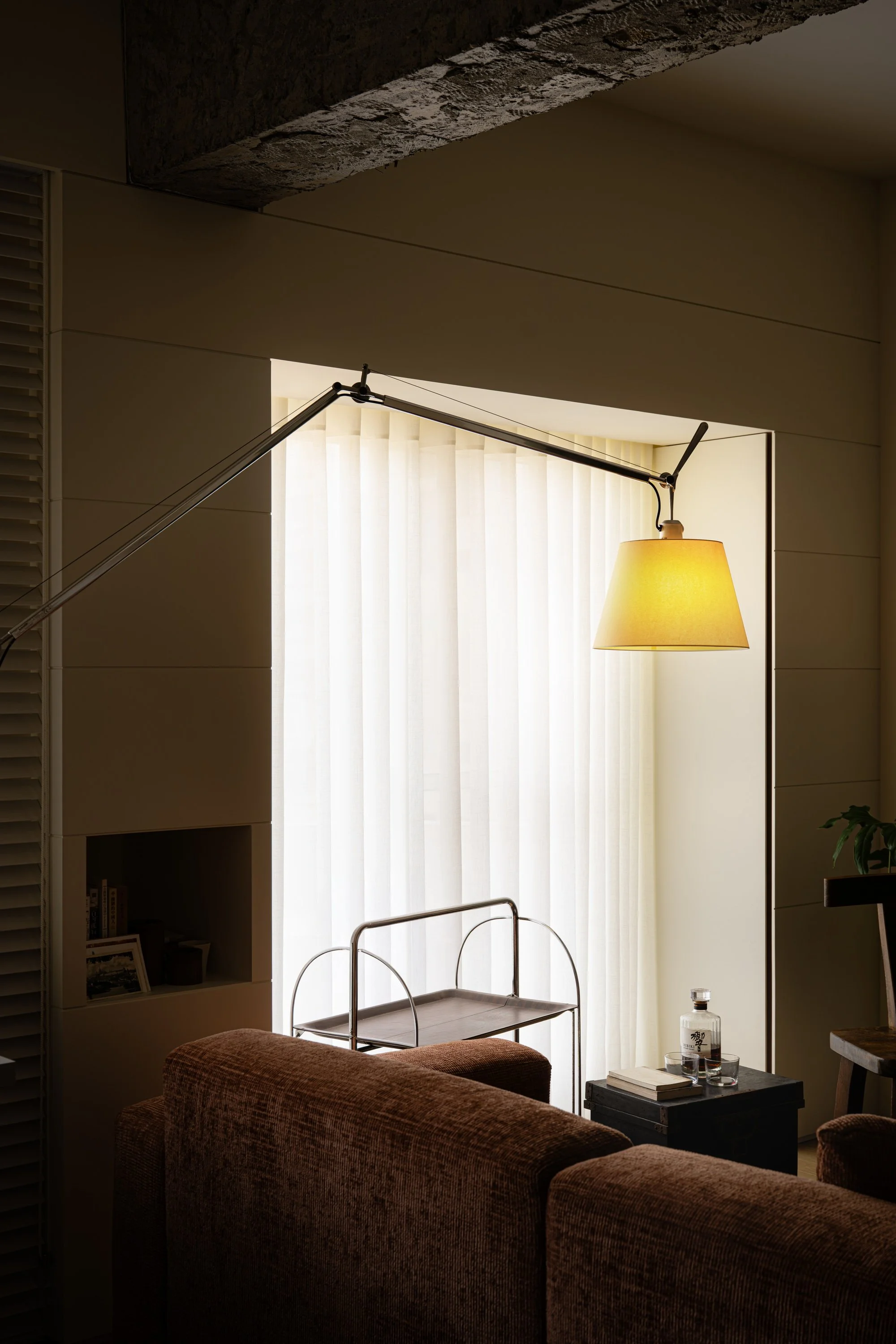
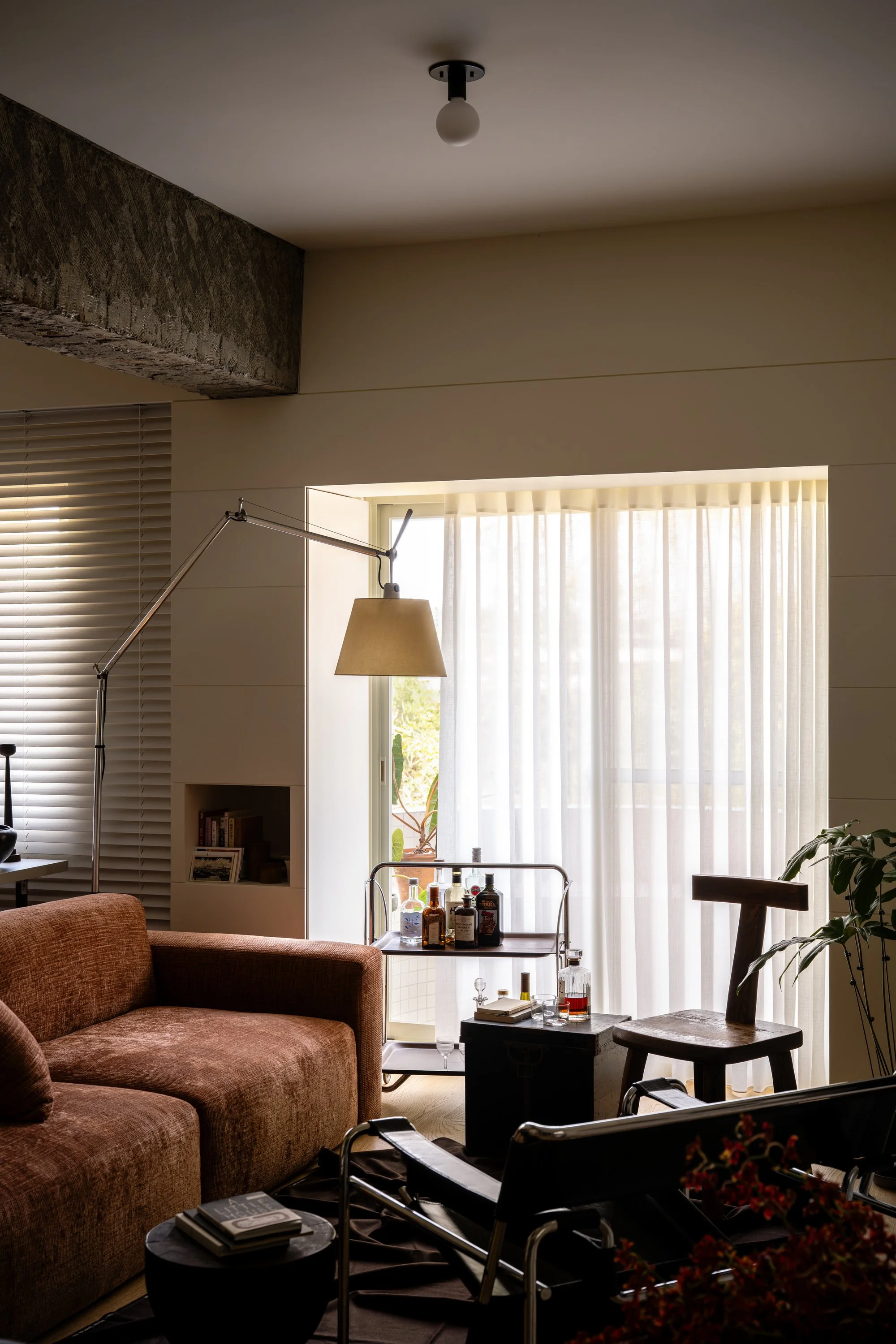
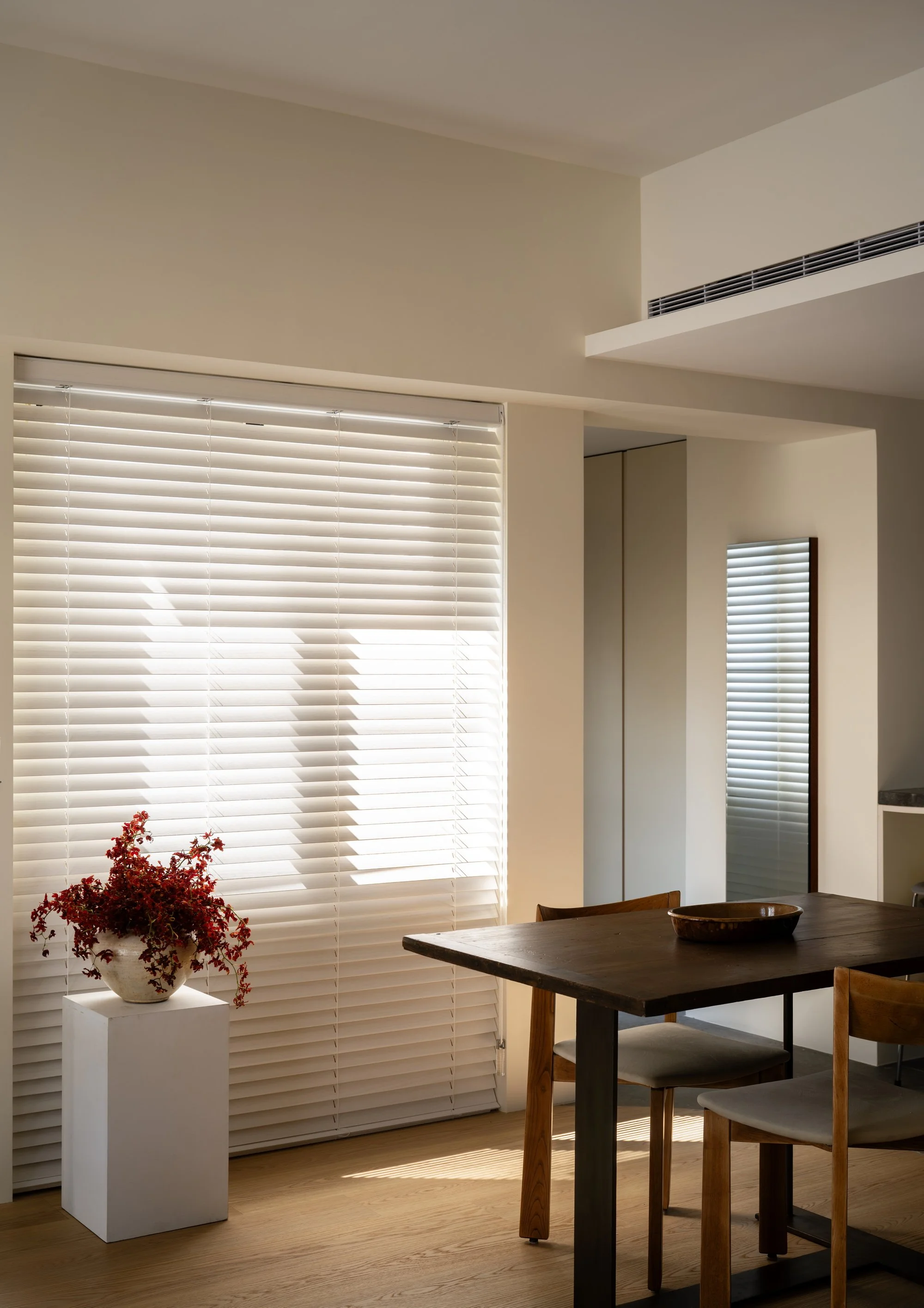
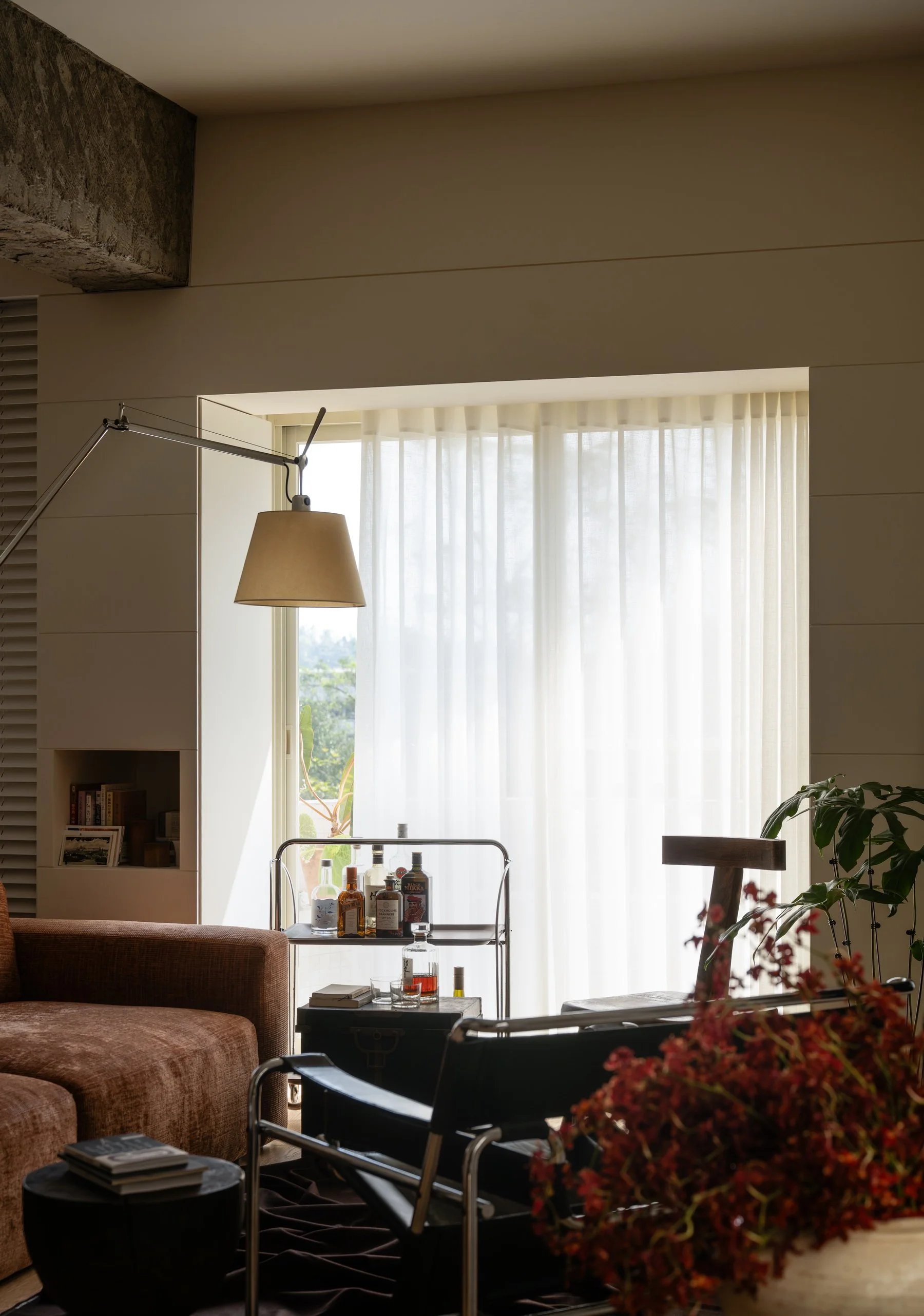
裸露的橫樑為空間保留了高度,混凝土的質地亦被視為一種自然材質,顯露其原始的量感。在低限且簡約的空間框架下,窗面的編排由俐落的百葉,聚焦至前側陽台的落地窗。沿窗邊將角柱包覆整平,結構感隨之凸顯,內部則隱藏收納機能;在靜謐的光暈之中,景深逐步凝聚,重心清晰地落於客廳。
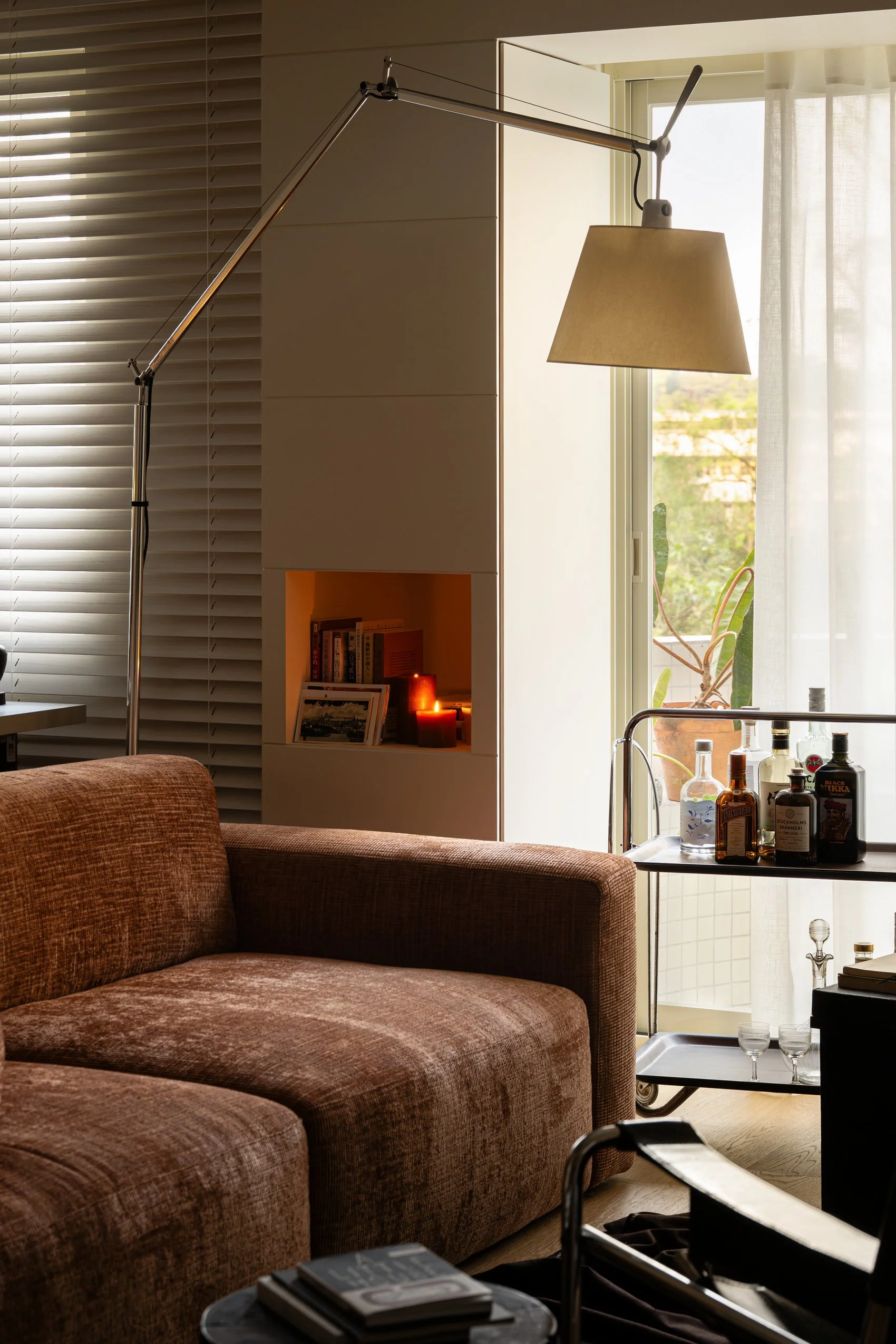
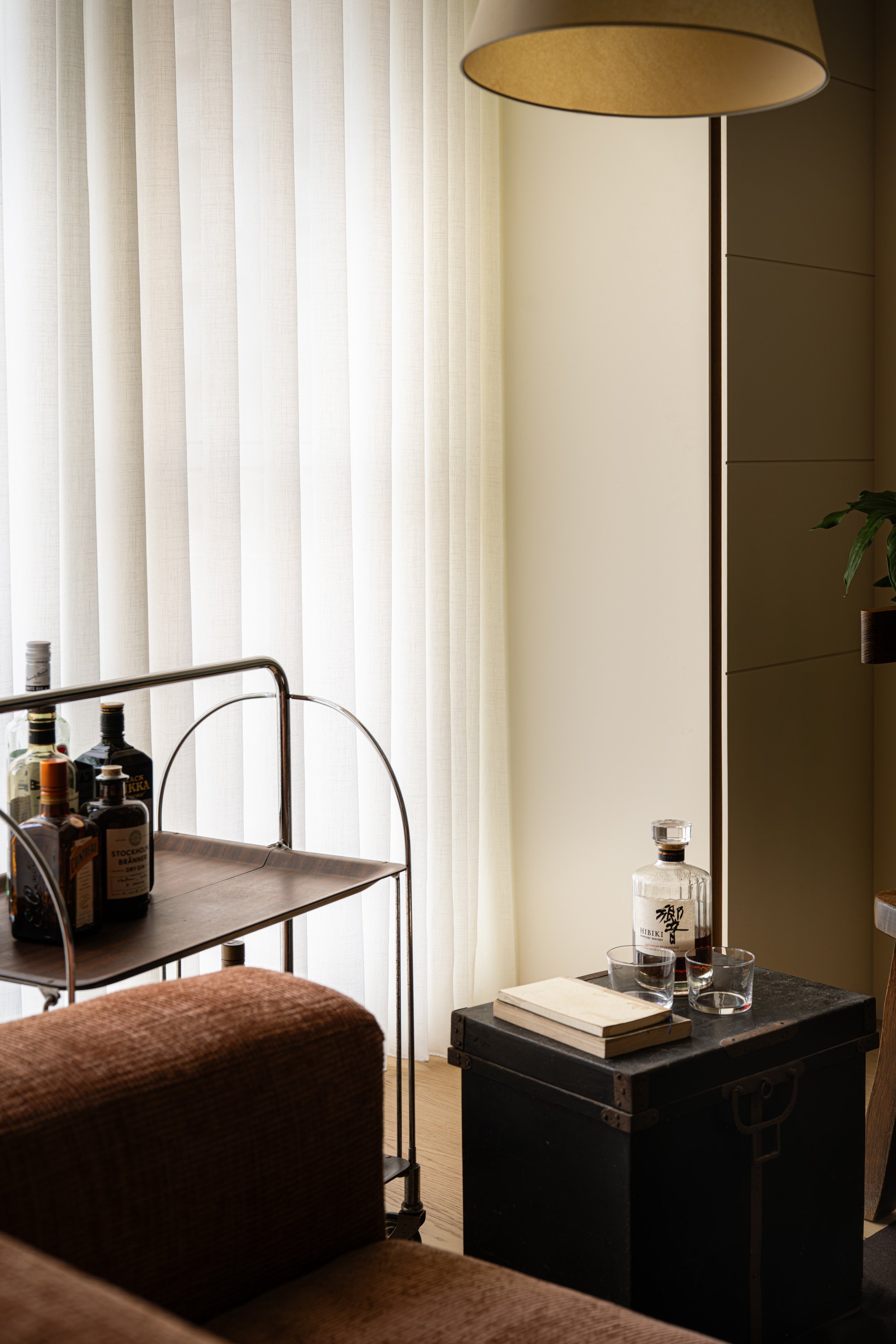
赭橘色的沙發定下空間的色彩主調,如日曬後略帶乾燥的絨面紋理,散發悠閒自若的暖意。ㄧ旁的老件推車成為行動的迷你酒吧,在日常小酌的時光之餘,也承載了屋主曾身為空服員的生活軌跡。
周圍的座椅、燈具與收納物件,透過經典設計與材質的對話,延續空間對結構與秩序的關注,平衡了整體空間的物件語言。
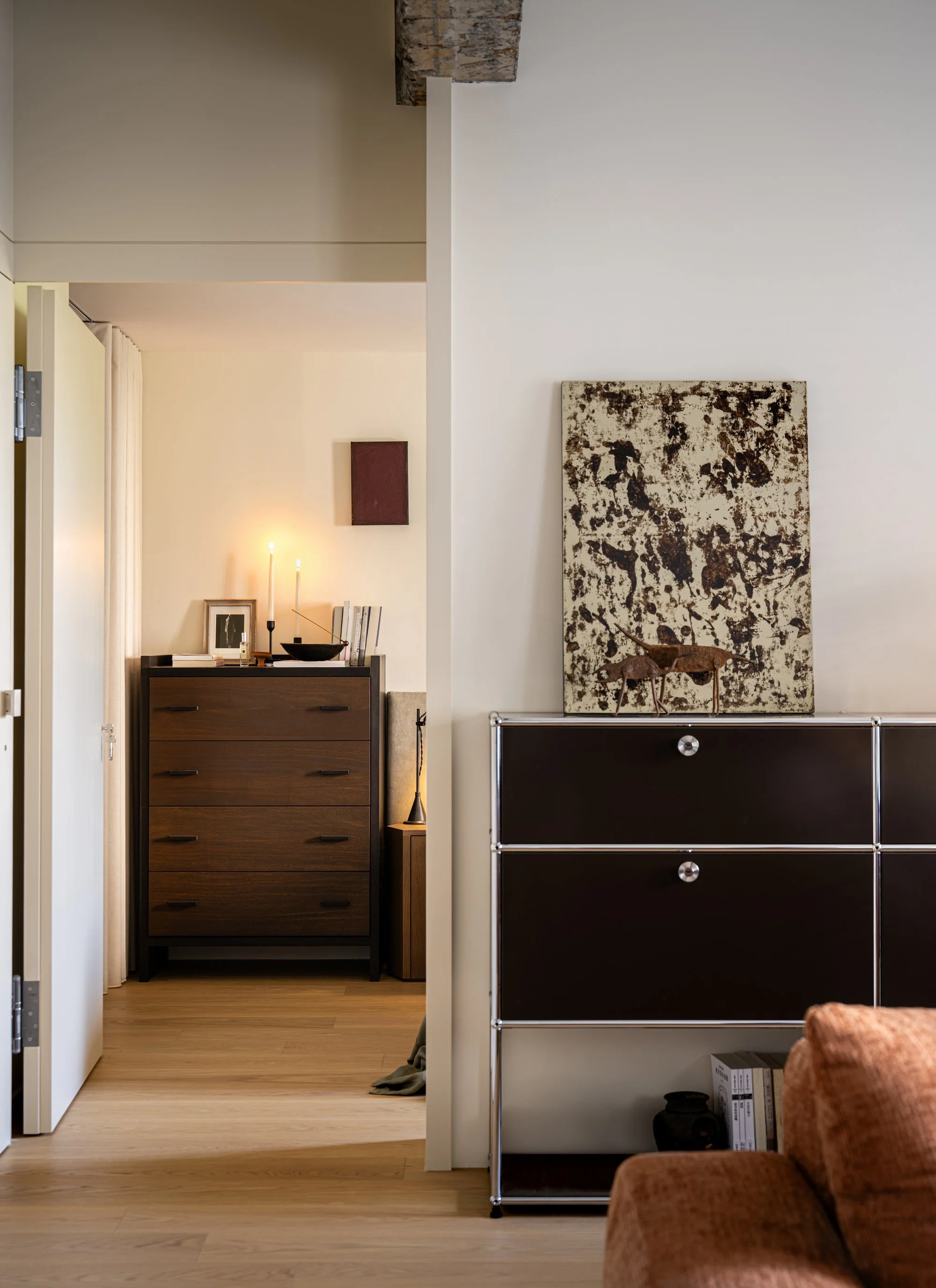
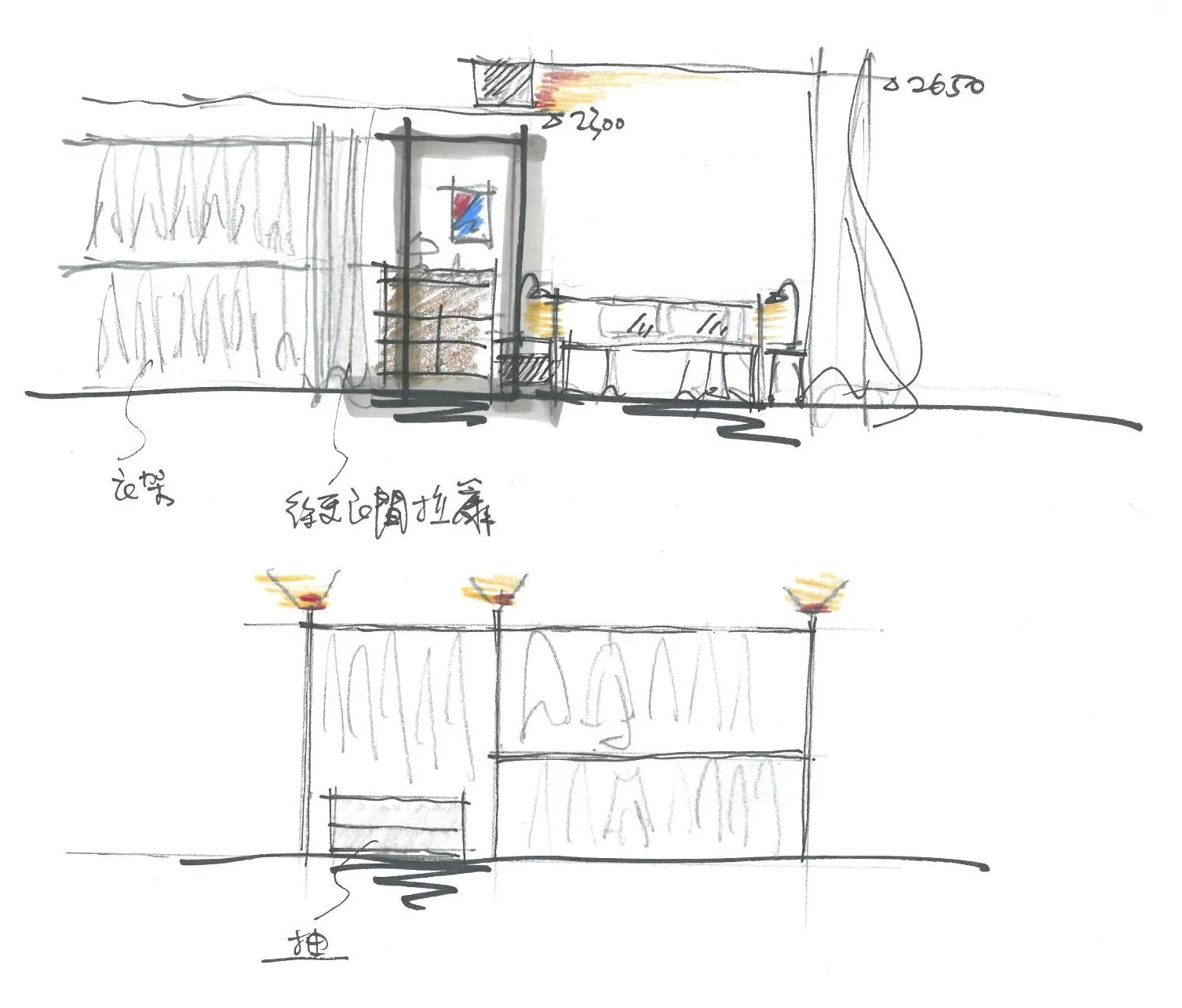
不同形式的燈具配置,成為空間中的點睛之筆。客廳僅以燈泡外露形式的頂燈補足基礎照明,呼應裸露的樑柱結構,也暗藏不拘一格的玩心;反將視覺焦點落於線條與結構鮮明對比的 Tolomeo 系列懸臂立燈,其力學結構與布面燈罩,讓光源在靈活之中仍保有優雅的姿態。USM 收納櫃上,一盞Angelo Mangiarotti 設計的桌燈,透過波浪造型的玻璃燈體,流動的光影悄然浮動出感性的氛圍,對映自百葉簾間滲入的微光。
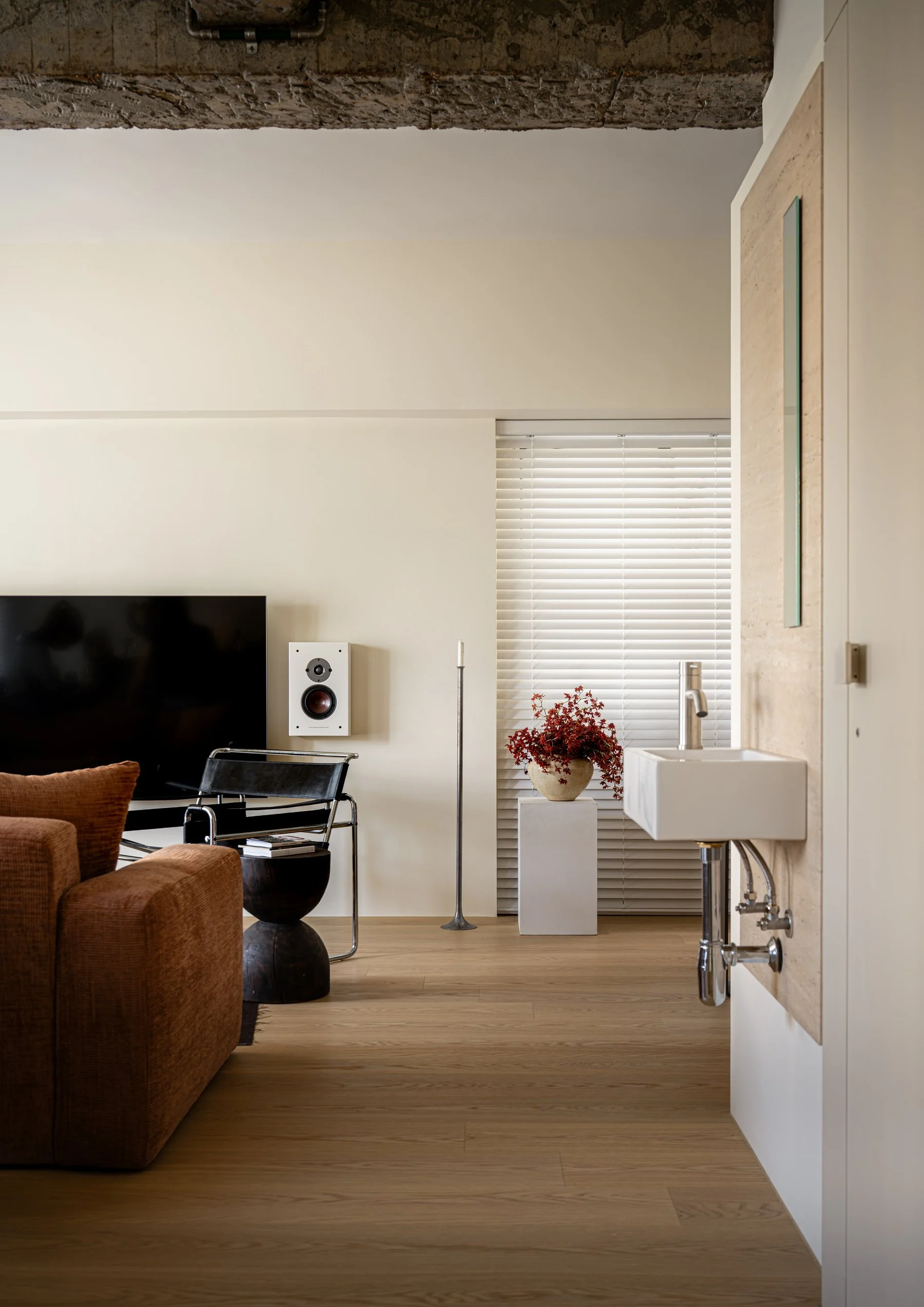
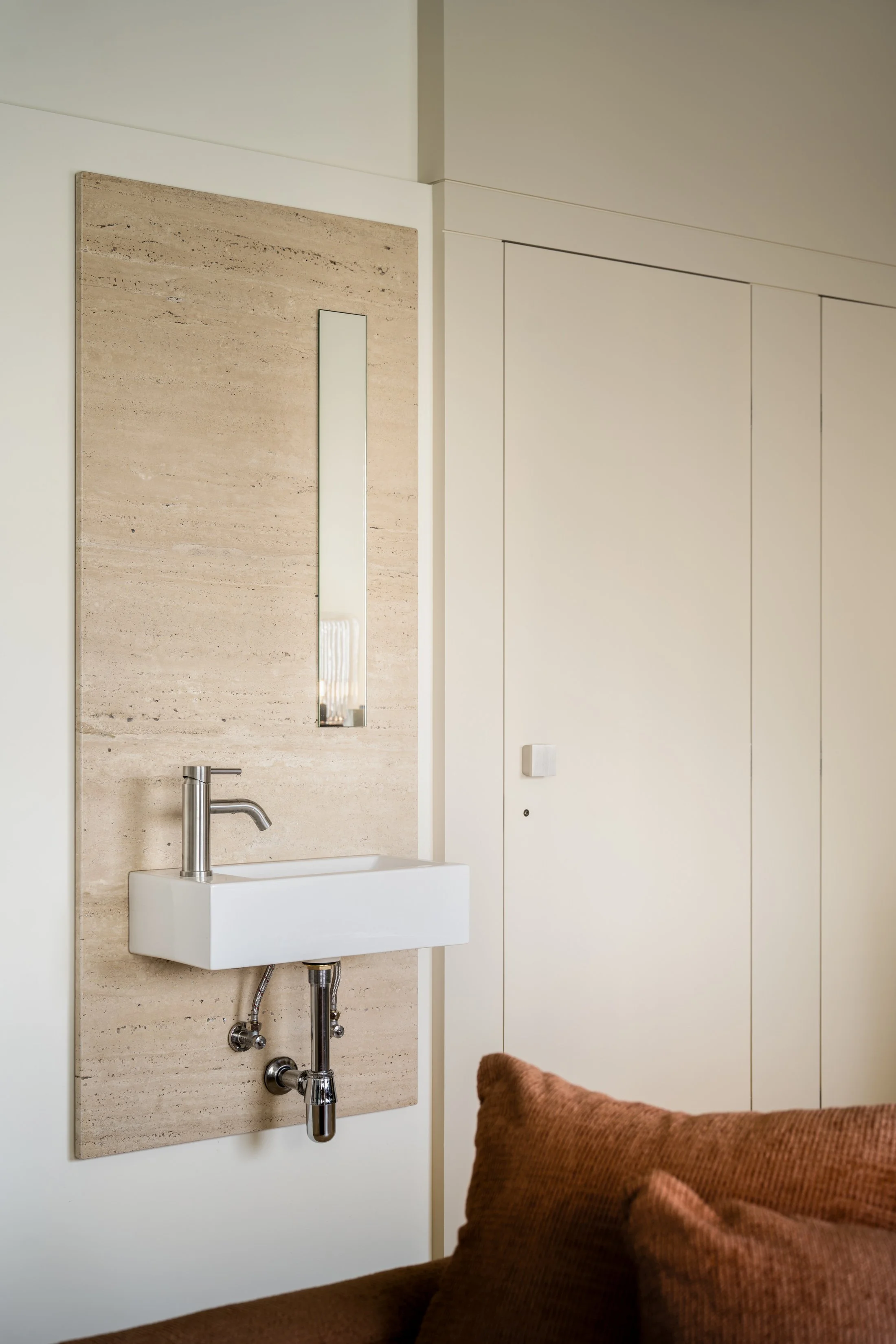
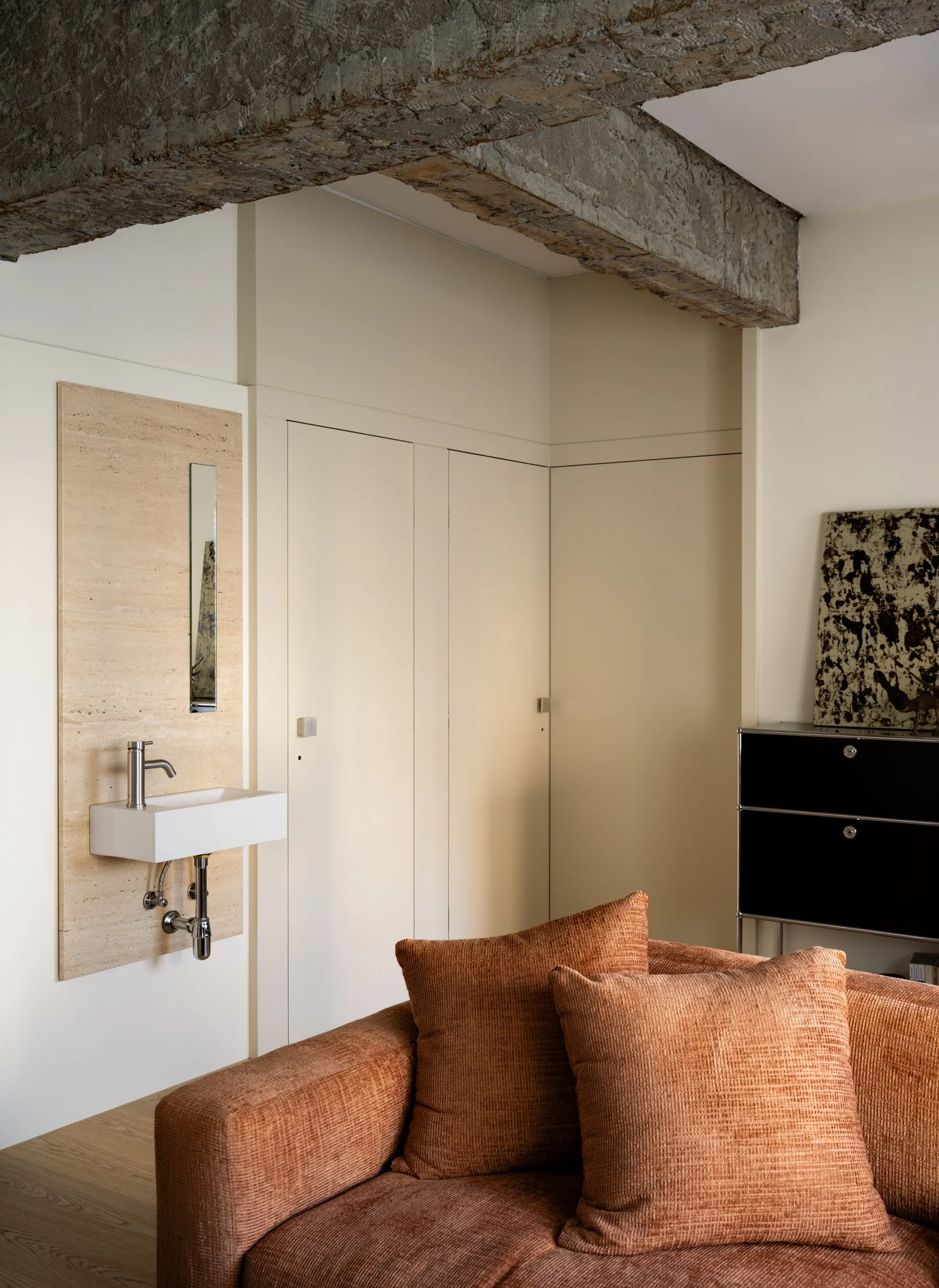
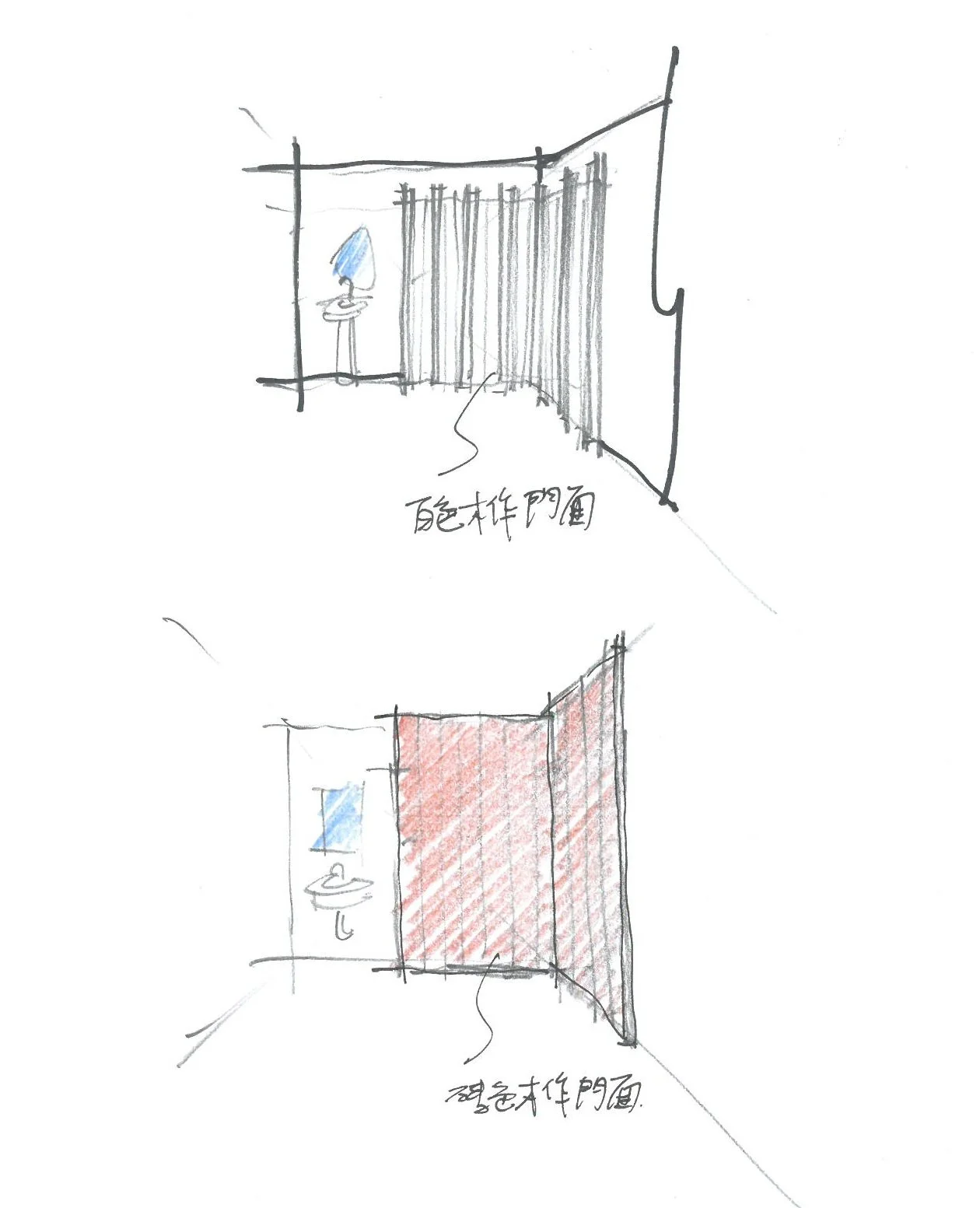
客廁與儲藏間等機能空間,置於整體佈局的中心;對外牆面與門片之間,透過細微的色彩差異,模糊了虛實之間的邊界。受限於尺度,洗手台移設至對外區域,牆面並以洞石與鏡面,將機能轉化為幾何的比例構成。
The primary living space integrates a work area set toward the rear with the living room at the front, forming a shared environment where multiple functions coexist.
Exposed beams preserve a sense of height within the space, while concrete surfaces are treated as a natural material in their own right, revealing an unrefined sense of mass and texture. Within this pared-back architectural framework, the window treatment is articulated through crisp blinds, drawing focus toward the front balcony doors. Along the window, corner columns are wrapped and brought into alignment, reinforcing the structural rhythm while concealing storage within. As daylight filters in, depth gathers toward the living room.
An ochre-toned sofa establishes the chromatic anchor of the space. Its finely ribbed upholstery carries a dry, understated warmth. Beside it, a vintage trolley—serving as a mobile minibar—also holds traces of the homeowner’s past life as a flight attendant, folding personal memory into everyday moments.
Surrounding elements—seating, lighting, and storage—extend this dialogue through classic forms and material restraint, quietly balancing the object language of the space.
Lighting serves as a series of defining accents. In the living area, exposed-bulb ceiling fixtures provide the base layer of illumination, echoing the honesty of the exposed structure. Visual emphasis shifts to the Tolomeo floor lamp, whose articulated arm and fabric shade introduce contrast through line and structure, as movement remains deliberate and the light holds its composure. Atop the USM storage, A table lamp by Angelo Mangiarotti refracts light through its undulating glass form, allowing subtle shifts to emerge alongside daylight filtered through the blinds.
Functional spaces, including the powder room and storage, are placed within the centre zone of the plan. Through subtle variations in colour between wall surfaces and doors, the boundary is softened. Constrained by scale, the washbasin is relocated to the outer zone, where travertine and mirrored surfaces translate utility into a composition of geometry and proportion.
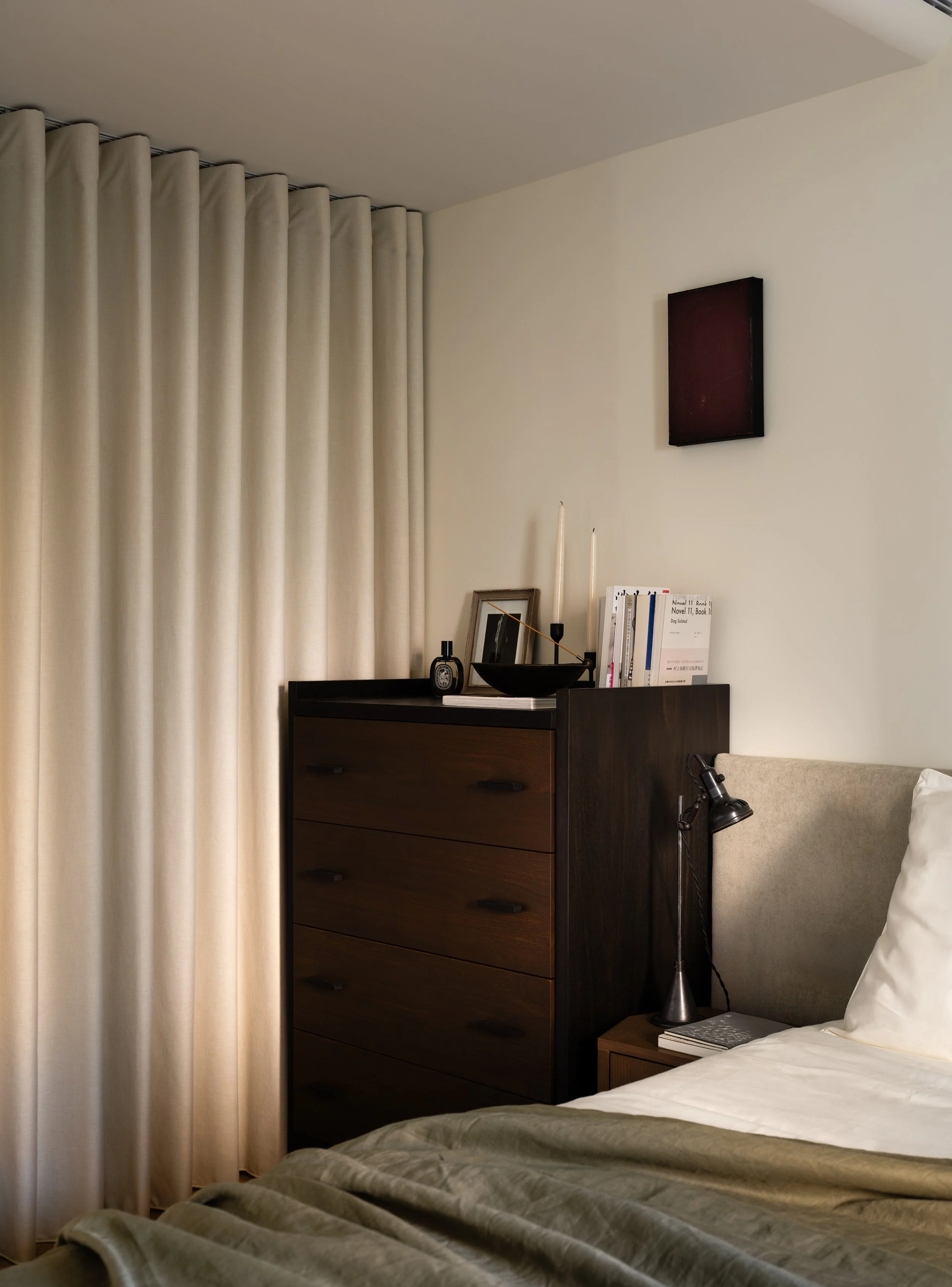
空間底端整合了主臥、更衣間與主浴,形成一處完整而延續的隱私場域;藉由拉簾作為靈巧且富於彈性的界定,讓日常在轉換之間,仍保有從容的步調與餘裕。
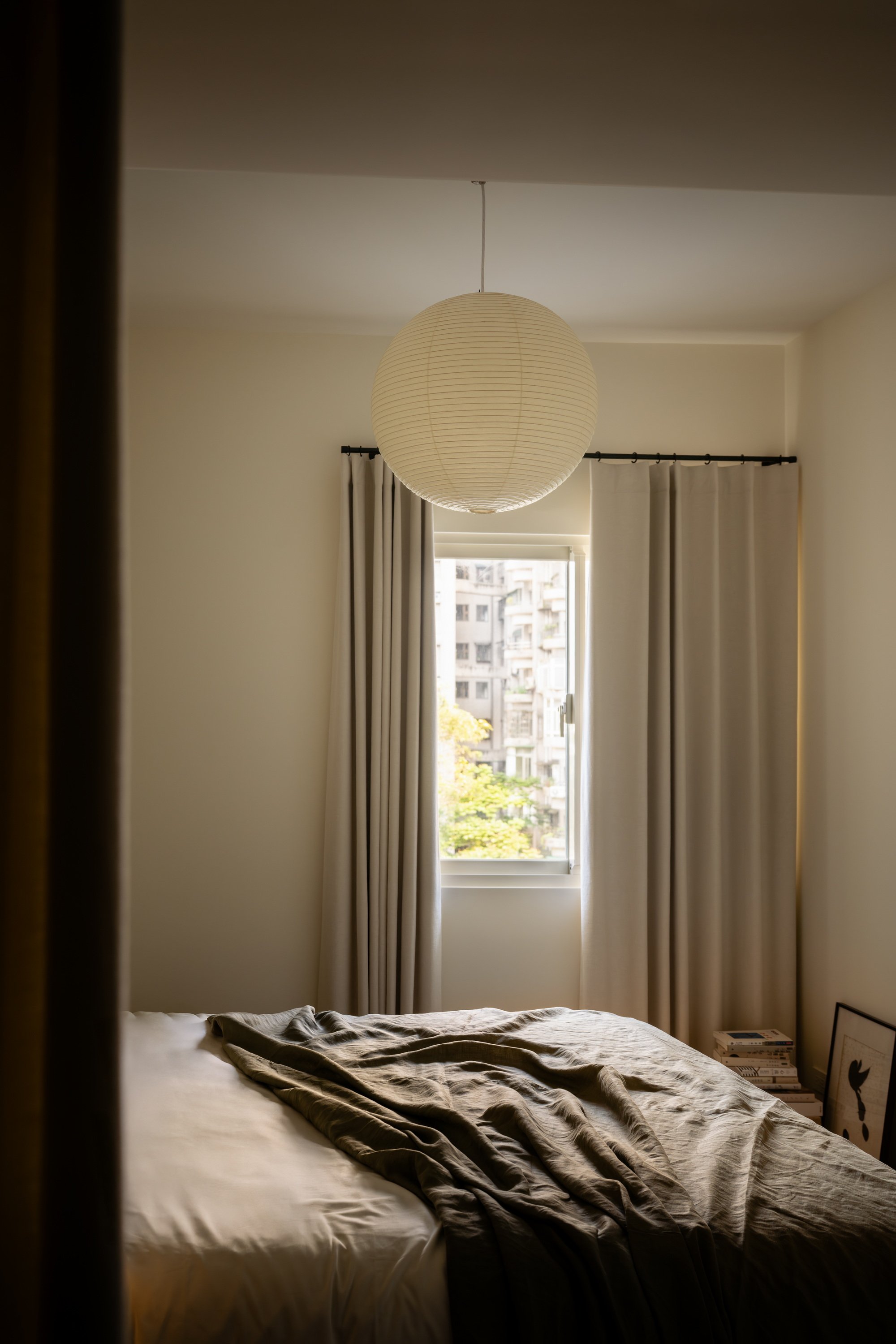
由主空間的視線延伸至主臥,一只別緻沉穩的斗櫃作為緩衝的端景,結合收納機能與日常擺設,使私領域的秩序自然落定。素雅柔和、織面密實的窗簾與床架,在色階與質感上統合呼應;一盞由野口勇所設計的和紙吊燈輕懸其間,光影朦朧,為空間覆上寧靜的留白。
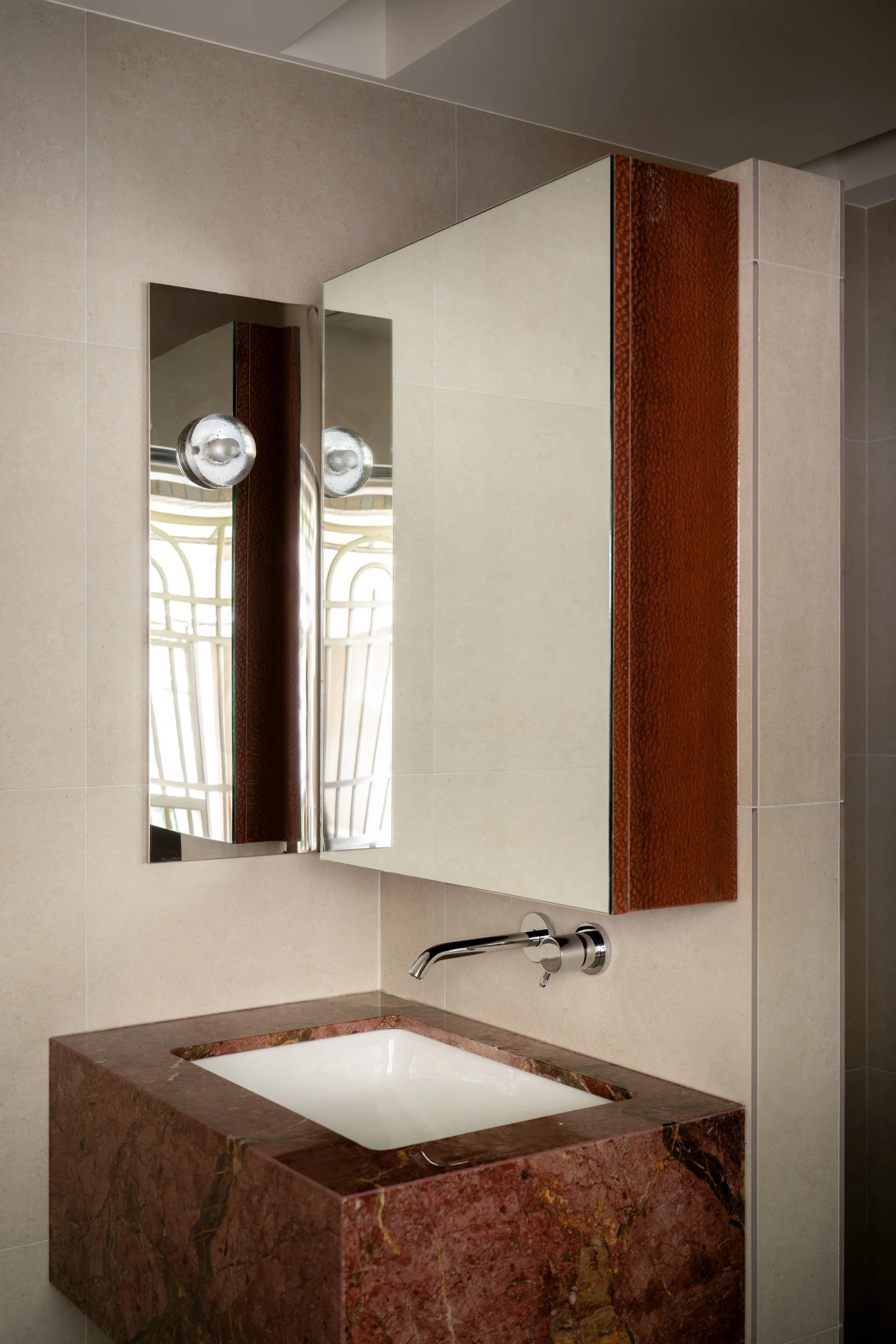
穿過更衣間,空間進一步收束,抵達主浴室。形制簡約的盥洗區仍透過材質、色彩以及比例,悉心鋪排;延續至側壁的一截鏡面中結合壁燈配置,映照出近似梳妝燈般的光感,成為精巧的點綴。特意保留厚實量感的盥洗檯,覆以如酒色沉澱後、朱釀般的石面,礦物的紋理質地在光影中隱隱浮現。於是,日常的喧擾悄然退場,只留下感官深處的迴聲。
Toward the end of the plan, the primary bedroom, dressing room, and main bathroom are integrated into a continuous private realm. Curtains are used as a flexible delineation, allowing the spaces to shift and overlap with ease.
Within this sequence, from the living area, the bedroom comes into view. A bespoke chest of drawers anchors the transition into the private quarters. It combines storage with surfaces for everyday objects, allowing order to settle. Beyond this threshold, softly toned, densely woven drapery and the bed frame are unified through a shared palette and texture. Suspended above, a paper pendant lamp by Isamu Noguchi casts a muted glow.
Passing through the dressing room, the space tightens, leading into the main bathroom. The wash area takes shape through its most essential forms, articulated through material, colour, and proportion. Along the side wall, a section of mirror paired with wall-mounted lighting recalls the balanced illumination of a dressing table, offering a precise yet understated accent. The vanity holds a substantial presence, finished in a deep, wine-toned stone, its mineral surface quietly revealed in the light. Here, the noise of daily life falls away, leaving sensation to echo.
攝影PHOTOGRAPHY/ IVAN
文字ARTICLE/ Yuwei
ENGLISH/ Yuwei